|
ENO
Cavalleria Rusticana & Pagliacci
26 Sep - 23 Oct
Ibs
A review by Barry Grantham for EXTRA! EXTRA!
Once again good old Cav & Pag ride in tandem, and the ENO’s new production at the Coliseum gives us a good opportunity to consider the merits and otherwise of changing the period, and sometimes the place intended by the original author, and whether such changes are justified or not. There are, I suppose, three or four reasons why this is considered an option. (1) A desire to make the work more acceptable to a wider, possibly younger and less elite audience At the Coliseum both operas are up-dated. Is this a good idea? In the case of one the answer is gloriously in the affirmative, and in the other, I think much less so. Cavalleria rusticana though occasionally unintentionally comic is a torrid tragedy of Sicilian revenge. Turiddu is conscripted on the eve of his marriage to Lola. During the years of his absence Lola breaks her vows by marrying Alfio. On Turiddu’s return, he soon finds an alternative, and shacks-up with Santuzza, promising her marriage. The original passion for Lola is, however, rekindled and – in this production he has it off with her behind a pile of chairs in the village hall. Trouble! Santuzza discovers his infidelity, and in a jealous rage alerts Alfio, who knifes Turiddu to death. Pagliacci ends with multiple deaths, but, in the present production, it is a hilarious and skilful comedy; the theme, a theatrical one - the ever popular play within a play. Tony, (the cast names are also updated) comes before the curtain to tell us what we are about to see is real – Nelly, the soubrette, fears the jealously of her husband, Kenny, who discovers her intention to desert him, but the show must go on – and he sings the famous aria ‘On with the Motley’ – ‘On with the make-up, the costume and powder’ in Lee Hall’s excellent adaptation. The show and life play themselves out, ending with Kenny shooting Nelly, her lover, and himself. The comedy is finished. This apparent absurdity is interestingly, loosely based on a true incident, where an actor accused of murder came up before Judge Vincenzo Leoncavallo, father of the composer. Back to the ‘Up-dating’ of Cavalleria rusticana - to Italy sometime just after World War II, and a period of incomparable drabness, made worse by the claustrophobic dreariness of the set, and the accurate but depressing costumes. It’s hard to think why two women thought Turiddu worth fighting over. I know ‘every old sticking finds an old shoe’ but need he have been made to look so unattractive – baggy brown trousers and braces don’t do a lot for a man. Then there is an almost unbelievable slowness of movement throughout, like something from the walking dead. ‘There is about to be a fight, we girls had better leave’ and they file out in a slow march. Then the lads enter to observe the fight, slowly as if they were coming to a temperance meeting. Men about to watch a knife fight don’t behave like that! Verismo? Nowhere near. Sometimes the effect is unintentionally comic; for example, when, after an impassioned duet, Turiddu is about to leave in high dudgeon, he re-crosses the entire stage to retrieve his wine bottle. Perhaps it was meant to be funny? If so, it wasn’t funny enough. But this is opera, and opera is all about singing, and the singing was a joy – above all of Jane Dutton as Santuzza and Peter Auty as Turiddu, who in the solos and the famous duet lifted the piece out of the humdrum to the magnificent. This duet is followed by a musical interlude beautifully played by the orchestra under Edward Gardner, in which the composer provides as a moment of reflection on the tortuous passion, just witnessed; passion that only opera can convey so intensely. On this occasion my own feeling is that Cavalleria rusticana could have been better served by the traditional pretty people in a pretty village setting.
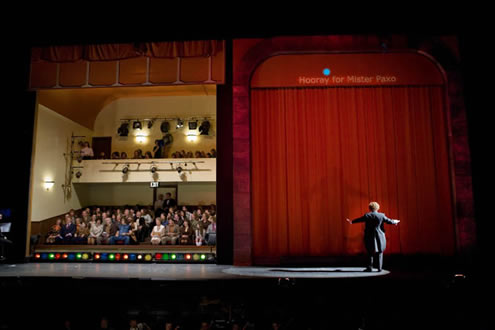
Then, returning after the interval, we awaited with trepidation for the curtain to rise on Pagliacci,our anxiety increased by the odd thing of the soloists from Cavalleria rusticana taking another bow. Surely they’re not going to play Pagliacci in the same dreary set? The curtain fell again and to our relief, the head of Christopher Purves as Tony, second comic of the Ding-Dong touring company pokes his welcome bespectacled face round the curtain, and reveals himself in his bright electric blue suit and does a very passable impression of …Who? Arthur Askey? Denis Nordon? Eric Morecombe? Olivier in The Entertainer? Amusing and quite skilful, however there is the problem of Mr Leoncavallo, who at the same time, requires him to sing the ‘Prologue’ which is set in a rhythm and style quite different than that employed by the aforementioned comics, but Mr Purvis is entertaining and we are willing to go along with the discrepancy. Moments later the fresh and cheerful set of the exterior of a provincial theatre delights our eye. From now on we are with the production hook line and sinker. There is more and more to delight us. The crowd moving, swelling, and contracting like those nature films of a thousand swallows on the wing. Bravo to movement director Linda Dobell. We meet the cast of the play and are introduced to Kenny the principal comic. He is a large man and, with the smaller bespectacled Tony, we see the parallel with ‘Little and Large’ which the programme invokes I think a little too strongly. Older members of the audience will remember them as the worst act (in spite of some talent in Large) to disgrace our television screen in those days. Next, we are invited backstage. Here are things just as they were; the bare boards, the brick walls painted black, the fly ropes, the working light and the old rehearsal piano. Upstage the supposed house tabs open, to reveal a view of the auditorium. The cast come onto the stage in a desultory manner, and odd stagehands amble about in an equally unenthusiastic manner; the chief electrician sits in the front row of the circle reading a newspaper. This is ‘Verismo’ believe me (for a time I played the variety halls in the 50’s). The electrician bestirs himself and experiments with the lights. Colours come from all directions, and the effect transforms the dull place into a place of beauty and enchantment. (Incidentally if anyone wants to know what it was like to work facing a battery of footlights – then called ‘floats’, recalling a time when they were actually wicks floating in small pans of oil – here it is). Nelly rehearses a musical number. She can twiddle a stick and she can dance. Again there is a discrepancy between the dance she is doing and the idiom required by the score, but she is every bit as sexy as the part could demand and boy can she sing! And we are into the plot. Tony, No 2 comic presses his attentions on her but is swiftly dispatched with knee to the groin. She is more responsive to the attentions of ‘tall longhaired and handsome’ (Woody?) and promises to run away with him. After his rough treatment Tony exposes her goings on to her husband Kenny who is very upset.
I’m sure the present production will have a long and distinguished life, though whether or not it will be served by such an excellent cast remains to be seen.
Listings information Dates: Sep. 26 Oct. 3,7,11,15,17,21,& 23 all at 7.30pm Venue: ENO at the Coliseum, St Martin’s Lane,London WC2N 4ES Box Office: 0871 911 0200 www.eno.org Tickets: £10 - £80 Ring box office for concessions.
Copyright © EXTRA! EXTRA All rights reserved
|