|
Simon Beyer in association with The White Bear Theatre Club, present
The Ides of March
White Bear Theatre Club
25 November – Sunday 21 December, 2008
A review by Alice McKenzies for EXTRA! EXTRA!
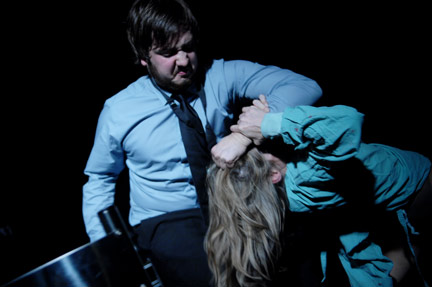
Both fantastic and haunting, The Ides of March takes place in an Australia one year on from a terrorist attack in which a nuclear bomb has annihilated the city of Melbourne. The Australian people struggle with grief and responsibility, as well as how far a society is willing to go to feel safe. The horror of the attacks on Mumbai filled the news on the day that I watched The Ides of March, and left the strange impression of a blur between reality and fiction. The accounts of the fictional characters began melting into the stories of the real survivors, and the condemnations of world leaders became spookily similar to those of their fictional counterparts. In fact the only aspect of the play that hints at more historical comparisons is the title. The Ides of March refers to the Roman name for the 15th of March, and is also most famous for being the day on which Julius Caesar was assassinated by his colleagues in the senate for his declaration that he would rule until he died. His murder was justified as a protection of democracy. In Duncan Ley´s play many people die in the name of democracy and the very idea of democracy itself is called into question. If a huge majority of voters support the idea of a suspension of the Geneva Convention to aid the battle against terrorism and allow them to feel safer, is it not democratic to do so? Or is it, as Robyn Moore´s passionate and biting lecturer believes, up to the “intellectual elite” to tell them what is best for them? Is it equally fanatical and patronising to try to impose your way of thinking on the disagreeing masses? Or does Laura present a voice of reason in emotionally battered times? It is tempting to read the play simply as a much repeated, George Orwell style warning about the loss of individual liberties. But if you let go of any preconceived ideas of what is right and wrong, the play can open up a far more complicated and morally ambiguous debate. Although Caesar´s assassination was in defence of democracy, the result was an autocracy. The Ides of March deals with ideas and the responsibility for ideas. However, it is also about individual grief and ways of dealing with loss. The small cast presents us with different characters whose responsibilities and relationships have led them to channel their grief in different ways. The memorial scene between Warren (a shiny politician played by Andrew William Rob) and his ex-wife Laura (Robyn Moore) where they mourn the loss of their son in the attack is moving for its realism. They present grief: tied up as it is in the history of their relationship to each other, to their own political ideas and their relationship to their son when he was alive. Warren uses his grief to give him the energy to uphold and defend a government struggling in the aftermath. Laura uses hers to fuel her campaign to defend civil liberties, and to prevent a repeat of the tragedy by seeking to understand its causes. Nine year old Joni, misses her mum so much that she begins to mimic her mother´s words when talking to her father. It is her account of the attack that forms the sound score powerfully composed by Sean Goodman, reminding us of the horror of it through innocent eyes. At first this came across as a bit cheesy, especially as the nine year old is played by an adult Jodi Kumblé, whose nine year old girl is far more wide-eyed than many nine-year olds that I know. However, some way into the play I realised that despite this I had started to look at her as though she were a child. And then we have Muslim father and son, Ahmed (the secular father played by Fanos Xenofós) and Hameem (the more devout son, played by Matthew Wade). Each find ways of dealing with waking up in a country where they are now not just individuals, but “them”, “the other”. They seek to deal with their individual sense of guilt, and their collective responsibility. The White Bear Theatre is a tiny venue, bringing the audience right on top of the action and emotion. At times this felt like too much - especially during the brutal Guantanamo Bay style second half. By being placed alongside the action, the audience shared in the characters lives, and it was not until a few minutes after the end of the play that I could really think about what I had seen. There was some clever use of space by director Adam Spreadbury-Maher, although at times The Ides of March did give the impression of wanting to burst out of its confines. It would be interesting to see the play in a larger theatre… A challenging play, The Ides of March adds a well acted thought to the current debate on terrorism, the state and the individual. Although easy to read as a George Orwell style dystopia, Duncan Ley´s script allows a questioning of democracy and the responsibility of ideas. Oh, and although this review may not have suggested it, it was funny at times too.
Box Office: 020 7793 9193 Please see booking information on the theatre website Tickets: £12 Full. £10 Concessions The White Bear Theatre
Copyright © EXTRA! EXTRA All rights reserved
|
 ary Couzens